


The Good Law Project has published the grounds of appeal lodged on behalf of some of the claimants in the failed judicial review of the EHRC Interim Update on the legal implications of the Supreme Court decision in For Women Scotland v The Scottish Ministers.
In summary (see a full analysis here), the Good Law Project and three other claimants challenged the lawfulness of the Interim Update on the basis that the Update contained errors of law and, if there were no errors of law, established that the Equality Act 2010 and the Workplace (Health, Safety, and Welfare) Regulations 1992 violated the rights of transgender people under the European Convention on Human Rights. The High Court rejected these arguments in their entirety, although one may be forgiven for concluding that this judgment constituted an important win for the GLP, at least if its campaigning material is anything to go by.
GLP has separately sought permission to appeal the decision that it did not have standing to take this case. Therefore, this appeal is lodged only on behalf of some of the claimants. Below, I set out the first main ground of appeal and provide some analysis. I hope to write other posts in the future which address the other grounds.
It is worth stressing at this point that the appellants are not challenging the conclusions of the High Court that permitting men to use female-only facilities could amount to sex discrimination and/or harassment against female service users. The liability risk for operating trans-inclusive facilities can be readily seen from high profile cases such as Peggie v NHS Fife and Hutchinson v NHS Darlington where women have successfully established that they have been harassed or discriminated against by trans-inclusive policies.
The Excluded Man
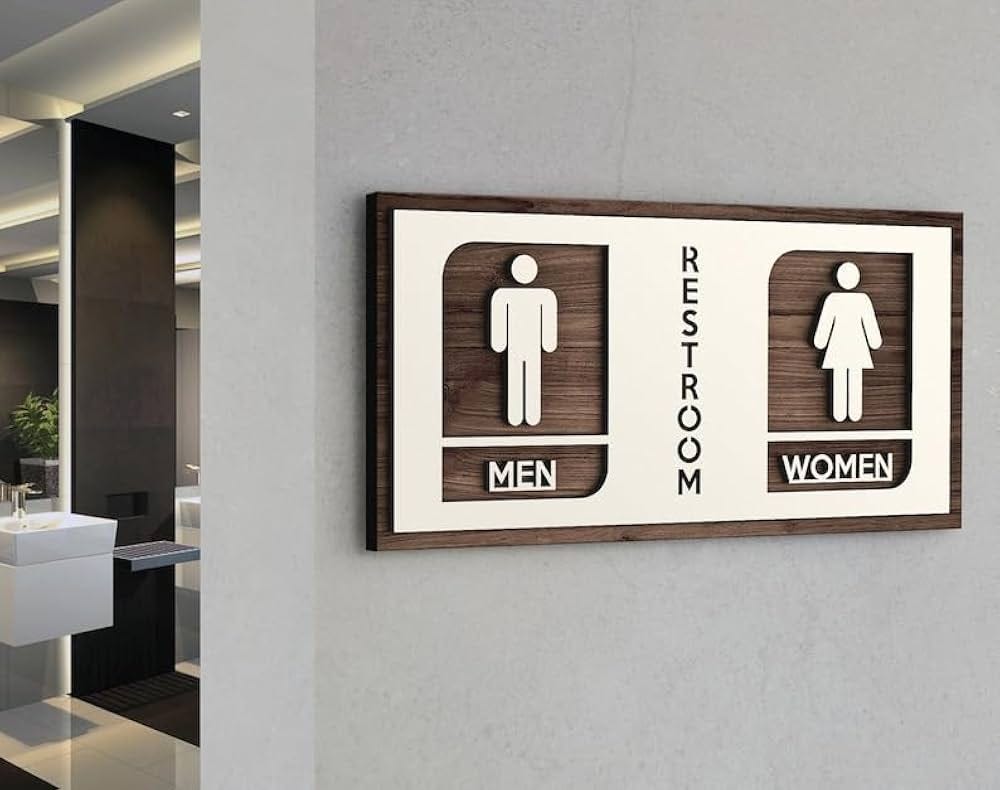
The first substantive ground of appeal relates to the finding of the High Court that the EHRC’s guidance contained no error of law when it stated that the inclusion of trans women (biological men) into female only facilities would mean that a service is no longer single-sex and must be open to all users of the opposite sex.
What The High Court Found
The statement from the EHRC contains two aspects; first the claim that a female-only facility would cease to be single-sex if some biological men were permitted to use them. This was dealt with quickly, with Swift J noting at [53] that ‘it is an inevitable consequence of the conclusion of the Supreme Court in For Women Scotland that in the EA 2010 “man” means a biological man and “woman” means a biological woman’. Swift J then considered the potential direct discrimination claim brought by a man excluded from a trans-inclusive women’s service:
57. The legal premise for point (vi) is that a man excluded from a trans-inclusive female lavatory (for the purposes of the EA 2010, a mixed-sex provision) would succeed on a claim of direct discrimination on grounds of sex.
58. In this scenario, not all men would be prevented from using the trans-inclusive lavatory. However, the direct discrimination claim would not fail for that reason: see and compare the judgment of Baroness Hale in R(Coll) v Secretary of State for Justice [2017] 1 WLR 2093 at paragraphs 28 – 31.
59. Whether point (vi) is correct will depend on the circumstances of the case and how, in those circumstances the matter of assessment that emerges from the judgments of the Court of Appeal in Smith v Safeway plc [1996] ICR 868 and R(Al Hijrah School) v HM Chief Inspector of Education [2018] 1 WLR 1471 is decided. The relevant matter is whether, notwithstanding that the man is differently treated, is he less favourably treated?
60. In Smith v Safeway an employer had a code on staff appearance which applied different rules for men and women. Men were required to have “… tidy hair not below shirt collar length. No unconventional hair styles …”. A man sporting a ponytail was dismissed. He made a claim of sex discrimination. The Industrial Tribunal dismissed the claim and that conclusion was upheld by the Court of Appeal. Phillips LJ stated (at page 878B – D).
“As Mr. Elias has pointed out, a code which made identical provisions for men and women but which resulted in one or other having an unconventional appearance, would have an unfavourable impact on that sex being compelled to appear in an unconventional mode. Can there be any doubt that a code which required all employees to have 18-inch hair, earrings and lipstick, would treat men unfavourably by requiring them to adopt an appearance at odds with conventional standards? … A code which applies conventional standards is one which, so far as the criterion of appearance is concerned, applies an evenhanded approach between men and women and not one which is discriminatory”
Leggatt LJ agreed (see at page 881G – H)
“Discrimination consists, not in failing to treat men and women the same, but in treating those of one sex less favourably than those of the other. That is what is meant by treating them equally. If men and women were all required to wear lipstick, it would be men who would be discriminated against. Provided that an employer's rules, taken as a whole, do not result in men being treated less favourably than women, or vice versa, there is room for current conventions to operate.”
In Al-Hijrah School, a co-educational primary school segregated pupils by sex from age 9. In an inspection report, school inspectors described this as direct discrimination on grounds of sex. The school challenged that conclusion. The court concluded, by a majority, that separate but equal treatment could constitute less favourable treatment and therefore discrimination; the different treatment was detrimental both to boys and girls; and that on the facts, both boys and girls were less favourably treated. The judges in the majority (Etherton MR and Beatson LJ) considered the decision in Smith v Safeway on which the school relied. The school had submitted the case was:
“74. … clear and binding authority that different but equal treatment for reasons of sex cannot constitute unlawful discrimination unless those of one sex are treated less favourably than the other sex, and so the same is necessarily true where they are treated similarly.”
At paragraph 76, the judges concluded:
“76. We do not consider that Smith’s case is of any assistance on this appeal. As the judge pointed out … the facts of that case are very different from those of the present case. They are so different, and the social context in which they arose was so different, that [the reasoning of the court in Smith] … cannot usefully be translated by analogy to the application of section 13 of EA 2010 in conjunction with section 85(2) of EA 2010 to the facts in the present case.”
61. Whether different treatment is also less favourable treatment is, therefore, a qualitative question. In a case where the provision of separate lavatories labelled male and female was materially similar in terms of the extent of the provision, location, and so on, I consider there would, in principle, be scope for a strong argument that a rule or practice that permitted trans women to use the “female” lavatory but required other biological men to use the male lavatory would comprise different but not less favourable treatment on grounds of sex. However, the circumstances of the case would be decisive. (For the purposes of the EA 2010 the lavatory would be mixed-sex, but for the purposes of the Claimants’ submission in this case it would still be labelled “women”.)
62. The Claimants put the same point in a different way contending that providing a transinclusive lavatory could be permitted positive action under section 158 of the EA 2010 and that for that reason, any claim of direct discrimination brought by a man would fail. I do not consider it necessary to consider this point separately. Insofar as it might further be said that section 158 would provide a response to the claim of indirect sex discrimination anticipated in point (iv) (the claim made by women when no single-sex provision was made), reliance on section 158 would not lead to consideration of any matter not already relevant to the justification defence to such an indirect discrimination claim.
…
77. … While I am less certain than the Interim Update that a man prevented from using the Claimants’ trans-inclusive female lavatory would be likely to establish the less favourable treatment necessary to make good a claim of direct sex discrimination, I do not consider that the way the point is put in the Update is necessarily wrong. Rather, it is a point that may turn on the facts of a situation. Even though the EHRC’s obligation when exercising its power under section 13(1)(d) of the EA 2006 is to provide an accurate statement of the law, the court must apply this requirement recognising that any statement of law will rest on some assumption of fact, even if only generic. Where a body such as the EHRC has issued guidance that rests on factual premises that are permissible, the court should hesitate before concluding that the guidance as issued was unlawful. Thus, I do not consider that the EHRC’s approach to point (vi) gives rise to any legal error.
In summary, Swift J concluded that it was an inescapable consequence of the Supreme Court decision in For Women Scotland that a facility open to both women and trans women is mixed-sex, not female-only. There is no error in law arising from that and it does not appear as though the appellants are challenging it. Instead, their arguments focus on the further point that because the service in question would no longer be single-sex, it must be open to all service users of the opposite sex.
Implicit within this is the understanding that if a service is no longer single or separate sex, it cannot rely on the Schedule 3 exceptions to defend against claims of sex discrimination. To avoid such claims, the service should not exclude a subset of men because of their (1) sex and (2) lack of transgender identity.
On that point, Swift J concluded that in order for an excluded man to have a viable claim in direct sex discrimination arising from his exclusion from a women-only service, he would need to be disadvantaged by the exclusion. Whether exclusion amounted to a disadvantage would depend on the facts of an individual case and therefore Swift J felt that a service provider could have a strong argument that the provision of ‘separate but equal’ facilities such as where communal toilets are provided for men and women separately does not constitute disadvantageous treatment of anyone. However, just because Swift J was of the view that such an argument could be run, he was not prepared to conclude that the EHRC guidance contained an error of law because any statement of law will rest on some assumptions of fact that support the general truth of the statement.
For example, the stamtent ‘the speed limit on this road is 40 km an hour; it would therefore be unlawful to drive above 40 km an hour’ presumes that one is not driving an emergency vehicle. Courts are reluctant to require those charged with issuing guidance on the law to conceive of or describe every possible scenario where general statements of law may be subject to fact specific exceptions. It would therefore be inappropriate for a court to strike down such a statement as unlawful merely because it didn’t contain the further statement ‘unless one is driving an emergence vehicle’. Similarly, it is a true statement to say that humans are bipedal, even if some people have only one leg and cannot walk. This statement is not false for failing to add in the caveat ‘except where medical conditions or injury result in the the inability to walk on two legs’. What matters when considering omissions is whether the omission is material enough to render the general statement false.
It would not have been appropriate for the court to require the EHRC guidance to caveat every statement of law with ‘unless the circumstances of the case would indicate otherwise’, not least because that would undermine the point of issuing guidance which is to provide an accessible and digestible indication of where the legal risks lie. Guidance is not bespoke legal advice intended to cover every concievable situation. Attempting to do so would result in ‘guidance’ which was unable to guide behaviour at all, leaving duty-bearers paralised. So long as the guidance contained accurate statements of law which were premised on presumptions the EHRC was entitled to make, the choice not to include repeated caveats to the effect that duty-bearers should seek bespoke legal advice on individual cases will not be an error of law. The EHRC is required to avoid mateial omissions. Swift J was satisfied that no such omission occured here.
It is important to remember two things at this point. The first is that the point of guidance from the EHRC is to provide practical information about the likely legal risks faced by duty-bearers under the Equality Act, with an eye to helping them to avoid liability. The second is that, even if an excluded man would struggle to establish a direct sex discrimination claim, that does not mean that the provision of a trans-inclusive facility is lawful. The High Court also upheld the accuracy of several points made by the EHRC in relation to the other liability risks faced by service providers, including claims of discrimination and harassment from women who are required to share single-sex facilities such as changing rooms with biological men. Even if GLP suceed on this point, that does not mean that it would be lawful to operate a single-sex toilet, changing room, or other facility on a trans-inclusive basis. I’ll set out my own views on the ‘excluded man’ issue further on in this post.
What the appeal is arguing
The appellants are aruing that Swift J erred in law by upholding the accuracy of the statement “trans women (biological men) should not be permitted to use the women’s facilities and trans men (biological women) should not be permitted to use the men's facilities, as this will mean they are no longer single-sex facilities and must be open to all users of the opposite sex.” They argue that this statement contains a material omission to the effect that there may be some circumstances where single-sex facilities can include members of the opposite sex without needing to be opened to all users of the opposite sex. The appellants advance three reasons for this.
First, the High Court presumes that a statement expressed in absolute terms will be accurate and lawful so long as it is sometimes correct. The appellants argue that this is an error of law; if an absolute statement is incorrect some of the time, this omits material qualifiers or caveats.
Notice how this objection is framed. Swift J concluded that the EHRC guidance was expressed in general terms. The apellants argue that it was expressed in ‘absolute’ terms. This is an important difference. Swift J did not say that the guidance was only sometimes correct; he noted that the guidance contained a general statement of law which rested on general presumptions the EHRC was entitled to make. In order for the appellants challenge to succeed, it would need to be unlawful for bodies such as the EHRC to issue general statements about the law which might not hold in all conceivable circumstances.
The central issue here is not whether there may be any circumstances where an excluded man would fail in a claim of direct sex discrimination; it is whether the failure to set out the circumstances in which such a claim might fail constituted a material omission. My own view, which I will set out below, is that Schedule 3 para 26 of the Equality Act heavily implies that ‘separate but equal’ services do constitute direct sex discrimination which are unlawful except where the conditions established in para 26 are met.
However, even if they do not always do so, it would be incumbent upon the appellants to identify the material circumstances in which a direct sex discrimination claim would fail. It could then be argued that the failure to include a caveat setting out those specific circumstances was a material omission. That is quite different from insisting that the EHRC include generic caveats to the effect that its guidance is always subject to the circumstances of a given case, without indicating what circumstances would be relevant. To require nothing more than a generic statement that the guidance depends on the circumstances would create exactly the conditions for muddying the water that would undermine the purpose of the provisions permitting the EHRC to issue guidance in the first place.
Swift J held open the possibility that an excluded man may fail to establish a claim in direct sex discrimination. This conclusion must be read in conjunction with the conclusions that there will be circumstances where women would succeed in claims of sex discrimination and harassment if required to use trans-inclusive women’s facilities. If all that EHRC guidance could say were generic statemetns that sometimes it will be lawful to do X and sometimes it will be unlawful to do X, then the guidance would be useless. At a certain point guidance must be expressed in general terms which actually provides guidance on how duty-bearers should act to reduce liability. The Interim Update did exactly that. Following that update is the best way for duty-bearers to reduce liability risk.
The reality is that a choice to exclude a portion of the population from a given service runs the risk of being unlawfully discriminatory, if a substantial reason for the exclusion is a protected characteristic. The traditional means of justifying separate facilities for men and women has historically not been to point to the fact that the provision is ‘separate but equal’; it has been to point to the express carve out in Schedule 3 para 26 which renders sex separated public services lawful under certain circumstances or to point to the Workplace (Health, Safety and Welfare) Regulations 1992 which mandate certain sex separated facilities in the workplace where single-user facilities are not sufficient or have not been provided.
If a service provider is choosing to operate a separated service which cannot rely on those express statutory carve-outs, the EHRC is within its rights to issue guidance against that, given the heightened liability risk. The face that one of the multiple potential claims warned of may not succeed in all circumstances does not render that guidance unlawful.
Second, it was an error of law to presume that there were any circumstances where an excluded man would suceed in a claim of direct sex discrimination. This is because the exclusion of a man who does not idenitfy as a woman would be on the grounds of ‘lived gender’ not sex.
This claim focuses not on whether exclusion constitutes a detriment, but whether it could ever be said that trans-inclusive services excluded men because of their sex. This claim simply misunderstands the nature of the ‘because of’ test for direct discrimination.
Sex need not be the sole reason for the less favourable treatment, so long as it can be shown that it was an important factor in the less favourable treatment (Owen & Briggs v James [1982] IRLR 502; O’Donoghue v Redcar & Cleveland Borough Council [2001] IRLR 61); Hewage v Grampian Health Board [2012] UKSC 37).
In Nagarajan v London Regional Transport [1999] IRLR 572, the House of Lords noted:
“Decisions are frequently reached for more than one reason. Discrimination may be on racial grounds even though it is not the sole ground for the decision. A variety of phrases, with different shades of meaning, have been used to explain how the legislation applies in such cases: discrimination requires that racial grounds were a cause, the activating cause, a substantial and effective cause, a substantial reason, an important factor. No one phrase is obviously preferable to all others, although in the application of this legislation legalistic phrases, as well as subtle distinctions, are better avoided so far as possible. If racial grounds or protected acts had a significant influence on the outcome, discrimination is made out.”
Similarly, in O’Reilly v BBC [2011] EqLR 225, the Employment Tribunal noted at [245]-[246]:
the prescribed reason need not be the sole reason, or even the principal reason, why a person suffers detrimental treatment. Part of the reason that a woman over 40 is precluded from applying for the job, in the above example, is the fact that she is a woman. Another part of the reason is that she is over 40. Both of them are significant elements of the reason that she suffers the detriment. In such circumstances, we consider it is clear that the woman is subject to both sex and age discrimination.
The way that this can be fitted with the comparative exercise set out in the legislation is that a woman over 40 can compare her treatment to a man over 40; by which exercise the sex discrimination element of the treatment is established. Similarly, the woman over 40 can compare her treatment to another person under 40, thereby establishing the age discrimination element.
The appellants are arguing that the reason for the exclusion of a man who does not identify as transgender from a trans-inclusive female only service is not sex but ‘lived gender’. I take ‘lived gender’ to mean nothing more than self-identification, not least because the appellants have provided nothing further by way of definition. In any event, this is not the relevant question. It is not relevant if ‘lived gender’ is the purported reason for exclusion. What matters is whether the sex of the person excluded would be a substantial reason for their exclusion.
The question which must be asked to determine whether the exclusion was because of sex is whether a comparator of the opposite sex in materially the same circumstances as the claimant would be included. In this case, the relevant comparator would be a woman who does not identify as transgender or does not ‘live as a man’ (whatever that means). Would she be included in a trans-inclusive women’s facility? The answer is obvious. It is therefore inescapable that the excluded man is excluded ‘because of’ sex for the purposes of a direct sex discrimination claim. Whether that exclusion constitutes less favourable treatment is a separate question to be addressed in further detail below.
Third, the High Court erred by declining to consider whether operating a trans-inclusive facility could be justified as permitted positive action under s.158 of the Equality Act.
In the judgment, Swift J declined to consider this issue separately from the direct discrimination claim because he was of the view that the justification test in s.158 which permits positive action to advance the position of those who share a protected characteristic where proportionate was already addressed in the judgment when he considered the justification test for indirect discrimination. The point Swift J was making was simple: in his view many of the exceptions contemplated by the claimants would depend on the facts of individual cases; general guidance need not address the facts of every exceptional case in order to be lawful; therefore the operative question is whether the guidance contained any material omissions which would render it incorrect as a matter of law. Swift J was of the view that it did not and that the guidance was therefore legally accurate and lawful.
Schedule 3 para 26
My own view on the issue of the ‘excluded man’ is that Swift J should have addressed the implication of the existence of Schedule 3 para 26 of the Equality Act. If he had done so, he may not have been quite so reluctant to agree with the EHRC position.
Schedule 3 contains three paragraphs which each relate to the provision of separate or single sex services. Para 26 makes provision for when it will not be unlawful sex discriminaiton to provide a service separately for men and women. Para 27 makes provision for when it will not be unlawful sex discrimination to provide a single-sex service. Para 28 makes provision for when it will not be unlawful gender reassignment discrimination to provide a single-sex service.
There is an important and relevant difference between a separate sex service and a single sex service. A single sex service is a service provided only to one sex. A separate sex service is a service provided to both men and women but on a separate based. For the purposes of this case, this is the relevant provision. Schedule 3 para 26 states:

Note the structure of this exception. There are two substantive provisions, the first setting out conditions where provision of separate services for persons of each sex can be provided and the second setting out conditions where separate services can be provided ‘differently’ for persons of each sex. For the former, all that need be established is that a mixed-sex service would be less effective and that the limited provision is proportionate. For the latter, it must also be shown that providing the service differently to one sex is justified by the needs of the other sex, bearing in mind the practicalities involved.
It is clear that para. 26(1) sets out the conditions for when ‘separate but equal’ provision for the sexes will be lawful and para. 26(2) sets out the conditions for then ‘separate and different’ provision for the sexes will be lawful. The inescapable implication of the existence of para. 26(1) is that this provision is needed to render lawful something which would not otherwise be lawful under the Act.
Put another way, if a service provider sought to provide a ‘separate but equal’ service for women and men but could not establish that a mixed-sex service would be less effective or could not establish that the separate but equal service was a proportionate means of achieving a legitimate aim, it would be counterintuitive to presume that the service provider could escape liability by simply arguing that ‘separate but equal’ services are nevertheless lawful because they do not treat anyone less favourably. As Lady Hale noted in R (Coll) v Secretary of State for Justice [2017] UKSC 40:
34. This brings us, therefore, to paragraph 26 of Schedule 3 to the 2010 Act (para 24 above). The history of the United States of America and of the Republic of South Africa, to take the two most obvious examples, has taught us to treat with great suspicion the claim that, if the races are segregated, “separate but equal” facilities can be provided for both, quite apart from the affront to dignity in the assumption that the races have to be kept separate. There have been periods in our own history where segregation of the sexes has led to separate facilities which were very far from equal. Paragraph 26 recognises that there may be good reasons for providing separate facilities for men and women. As Ms Rose points out, paragraph 26 proceeds on the assumption that, without it, the provision of single sex services would be unlawful discrimination.
This must be correct. If it were not, then para.26(1) would be a dead letter; there would be no need to meet the tests set out in the provision because ‘separate but equal’ services would generally be lawful unless it could be shown that the provision was actually different between men and women, to the advantage of one over the other. However, that would also render para. 26(1) superfluous because para. 26(2) makes provision for ‘separate and different’ services.
Swift J was of the view that exclusion of a man from a women’s facility might not be direct sex discrimination if the man is provided with a separate men’s facility of equal quality because his exclusion would amount to separate but not less favourable treatment. If that were correct, however, that would render Schedule 3 para. 26(1) redundant. If the only claim that a man could bring in sex discrimination arose from the fact that he had been treated separately and less favourably (separately and differently in the language of Lady Hale in Coll at [35]), then the only circumstances in which para. 26 would be engaged would be if the conditions in para. 26(2) were engaged. This cannot be right.
The Supreme Court in Coll was correct to note that paragraph 26 proceeds on the assumption that, without it, the provision of single sex services would be unlawful discrimiantion. Without para. 26(2) the provision of separate and different facilities would be unlawful and without para. 26(1) the provision of separate but equal facilities would be unlawful.
Applying this reasoning to the case of a trans-inclusive women’s facility, it must be recognised that the provision of ‘separate but equal’ facilities can amount to discriminatory treatment. Once that is accepted, the question to be asked is whether this is a case which involves sex discrimination. In my view, that question has an obvious answer: the excluded man would be included if he were a woman. Exclusion being less favourable treatment which is because of sex, the only defence available to a service provider is that there is an applicable exception which permits this kind of discrimination. No such exception is to be found in Schedule 3 because the exceptions there pertain to single and separate sex services. A trans-inclusive women’s facility is not such a service. It is a mixed-sex service for the purposes of the Equality Act.
In my view, it is clear that the distinction between para. 26(1) and para. 26(2) intends to cover both ‘seperate but equal’ and ‘seperate and different’ services. That distinction is evidently one which presumes that for sex separation in public services, the act of separation is itself discriminatory, even if the provision is identical. To protect against direct sex discriminaiton claims arising from the provision of seperate but equal services, para. 26(1) sets out a test to engage the exception. There is then further provision made for separate and different services which, in addition to sex separation, also treat one sex less favourably than another. To protect against direct sex discrimination claims arising for the provision of separate and different services, para. 26(2) sets out a test to engage that exception.
The fact that there are two tests covering both separate but equal and separate and different services means that, in my mind, Swift J was wrong to suggest that a respondent to a sex discrimination claim brought by a man would have a strong argument that the provision was ‘different but not less favourable treatment’. Bearing in mind the wording of para. 26, read in conjunction with the Supreme Court analysis of it in Coll, I would be inclined to say that this is a weak argument at best.
This being the case, I would hope that this issue is dealt with in detail on appeal, should permission be granted. I hope to write about the other grounds of appeal in the coming weeks.
Thanks for a great demolition of ground 1, Michael. Why on earth are people still funding these clowns!!!
Look forward to your next piece.
Have cross posted
https://dustymasterson.substack.com/p/the-last-waltz
Dusty
Thanks for taking the time to break this down. Very helpful, as always.